
GDPR — Controlli Tecnici
This page documents technical controls that can support a GDPR-compliant processing architecture. It is not a legal opinion, certification, or statement that Factum Parse is independently certified compliant.
Matrice di conformità GDPR
Sezione intitolata “Matrice di conformità GDPR”| Principio GDPR | Controllo tecnico | Implementazione |
|---|---|---|
| Art. 5(1)(c) — Minimizzazione | Elaborazione RAM-only per testo diretto | POST /v1/parse con text non crea job persistente. Nessun write su DB. Il payload esiste solo in RAM per la durata della richiesta. |
| Art. 5(1)(e) — Limitazione conservazione | TTL esplicito su artefatti upload | Oggetti S3: default 1 giorno. Cache job: TTL configurabile. Nessun retention indefinito. |
| Art. 25 — Data Protection by Design | Pseudonimizzazione PII prima dell’LLM | Sidecar Rizzo analizza e sostituisce 22 categorie PII in-RAM. L’LLM vede solo testo pseudonimizzato. Mapping restore locale dopo risposta LLM. |
| Art. 28 — Responsabile trattamento | Confine EU per elaborazione | Infrastruttura Hetzner eu-central (Nürnberg). Sidecar Rizzo in stessa VPC. Architettura progettata per sanitizzazione request-scoped in memoria volatile prima della chiamata a modelli esterni. |
| Art. 32 — Sicurezza del trattamento | Fail-closed su privacy | Sidecar Rizzo non raggiungibile → HTTP 503. Mai testo scoperto all’LLM. Non esiste degradazione a testo plaintext. |
| Art. 32 — Autenticazione | X-API-Key con confronto constant-time |
secrets.compare_digest(). Chiave assente/errata → 401. Fail-closed: chiave non configurata → tutti gli endpoint bloccati. |
| Art. 32 — Rate limiting | Middleware Redis-backed | 60/100/1000 req/min per tier. Protegge da abuso e DoS. Fail-open se Redis non configurato. |
Flusso ZDR — zero data retention
Sezione intitolata “Flusso ZDR — zero data retention”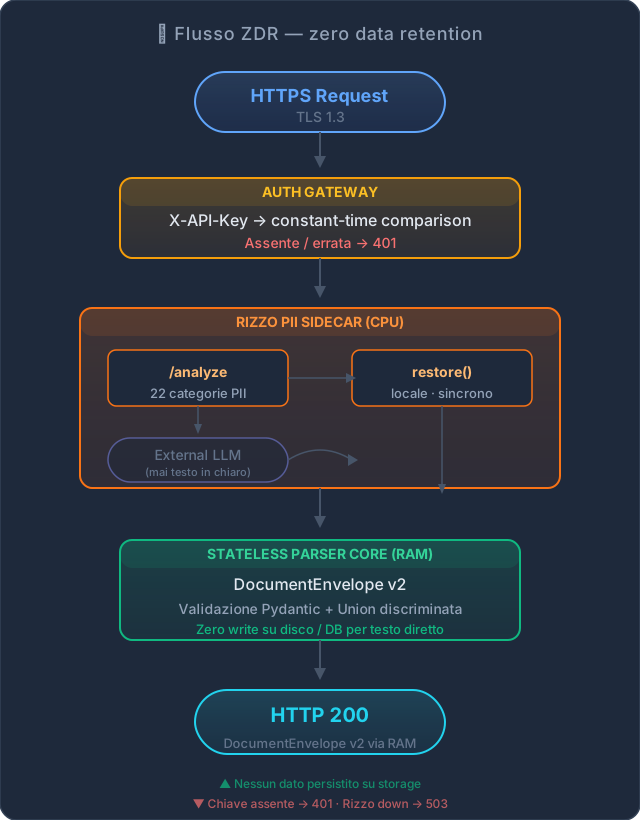
Article 5 — minimisation and storage limitation
Sezione intitolata “Article 5 — minimisation and storage limitation”The strongest current guarantees are scoped to the actual data path:
- Direct
POST /v1/parsetext is request-scoped and does not create a persistent job. - The Rizzo PII mapping is held in RAM for the request and used for local restoration.
- With
RIZZO_PII_REQUIRED=true, clear-text input is not deliberately sent to the external LLM when the sidecar is unavailable; the request fails closed with503. - Uploaded XML/PDF files are not zero-retention: the current backend supports object storage with a default one-day lifecycle, plus job/cache persistence with explicit TTLs.
- Deterministic FatturaPA XML results can contain the original structured invoice data in the job/cache path. Do not describe those records as PII-free.
Article 25 — data protection by design
Sezione intitolata “Article 25 — data protection by design”The relevant design controls are:
- PII pseudonymization before the external LLM path.
- Local, request-scoped restoration using the Rizzo mapping.
- Fail-closed behavior when the required privacy sidecar is unavailable.
- Bounded upload/body sizes to reduce memory and denial-of-service exposure.
- Hash-based deduplication and explicit TTLs for persisted upload artifacts.
These are implementation controls, not a certification of Article 25 compliance.
Article 32 — security of processing
Sezione intitolata “Article 32 — security of processing”| Control | Current implementation |
|---|---|
| API authentication | X-API-Key; constant-time comparison |
| Privacy gate | Rizzo sidecar before external LLM path |
| Fail-closed privacy | Sidecar unavailable → 503 when required |
| Upload bounds | 10 MiB transport/upload ceiling |
| Rate limiting | Redis-backed middleware when enabled |
| Runtime observability | Prometheus metrics |
| Storage lifecycle | Explicit object/cache TTL configuration |
EU / sovereign processing claim
Sezione intitolata “EU / sovereign processing claim”The intended architecture is EU-hosted processing with a clear-text PII boundary before the external LLM path. The phrase “sovereign EU/IT infrastructure” should therefore be read as an architectural positioning statement, not as a legal status or blanket guarantee about every upstream provider.
The exact deployment region, storage provider, LLM provider and contractual data-processing terms must be verified for the production environment before making a stronger residency or GDPR claim.
Operational evidence
Sezione intitolata “Operational evidence”For an audit, the useful evidence is not marketing copy. Preserve:
- backend source and configuration;
- deployment configuration for storage/region;
- Rizzo runtime configuration;
- access/control logs where appropriate;
- reproducible tests for the privacy gate;
- retention/TTL configuration and deletion evidence.