
API Overview
Base URL
Section titled “Base URL”https://api.factum.pyragogy.org
The API is built on FastAPI/OpenAPI. Marketplace deployment is a proxied distribution channel; the public URL and authentication injection may differ from the origin API contract.
Authentication
Section titled “Authentication”Business endpoints require:
X-API-Key: <your-api-key>The backend is fail-closed: a missing or invalid key returns
401 Unauthorized. Comparison uses secrets.compare_digest.
Public endpoints:
GET /healthGET /status
Request Sources
Section titled “Request Sources”POST /v1/parse accepts exactly one source:
| Field | Type | Required | Notes |
|---|---|---|---|
job_id |
UUID | XOR | Job returned by /v1/uploads |
text |
string | XOR | Stateless input, request-scoped |
doc_type |
enum | no | auto, fattura, f24, generico; default auto |
async_mode |
boolean | no | Async mode; not valid with text |
callback_url |
HTTP URL | no | Webhook for async. Only with async_mode=true |
job_id and text are mutually exclusive — exactly one must be present.
Upload
Section titled “Upload”POST /v1/uploads accepts a single multipart field:
file=<XML or PDF>There is no separate filename field in the backend contract; FastAPI receives the filename as UploadFile.filename metadata.
The transport and semantic limit is 10 MiB (max_body_bytes and max_upload_bytes). Supported document classes are FatturaPA XML and invoice PDF.
💨 Processing latency (measured)
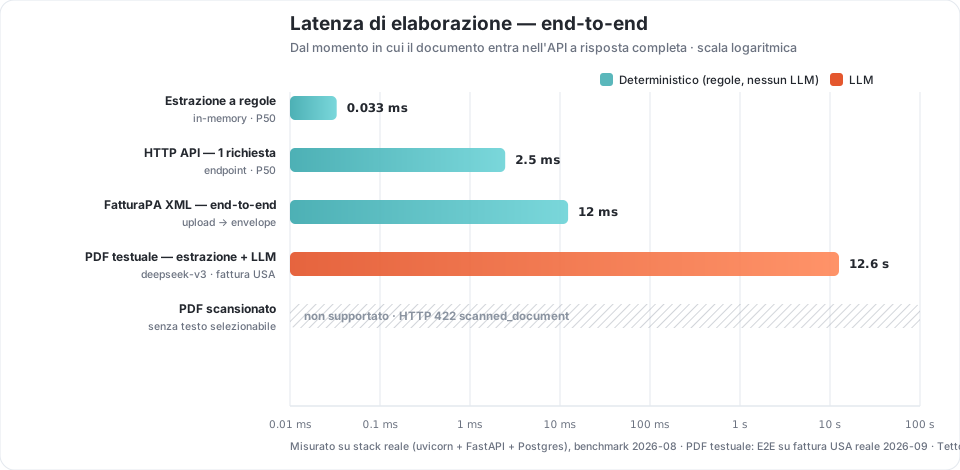
Section titled “💨 Processing latency (measured)”End-to-end latency, from the moment a document enters the API to the complete response. Logarithmic scale: deterministic paths answer in milliseconds, the LLM path in seconds.
| Path | Measured latency | Engine | Notes |
|---|---|---|---|
| Rule-based extraction (in-memory) | ~0.03 ms (P50) | Deterministic | No LLM |
| HTTP API — single request | ~2.5 ms (P50) | Deterministic | Real-stack benchmark |
| FatturaPA XML — end-to-end | ~12 ms | Deterministic | Recommended for integrations |
| Text PDF (extraction + LLM) | ~10–15 s | LLM (deepseek-v3) | Improvement margin on the roadmap |
| Scanned PDF | not supported | — | HTTP 422 scanned_document |
What this means for you
Section titled “What this means for you”- XML integrations (FatturaPA): deterministic path, ~12 ms, no LLM.
This is the recommended primary path: low latency, stable cost, guaranteed
result from verified arithmetic (
total ≈ net + VAT). - Text PDF: supported, but the LLM path takes ~10–15 s. Improvement on this latency is on the roadmap — it remains a valid path for unstructured documents (foreign invoices, F24, free text).
- Scanned PDFs (no selectable text): rejected with
422(scanned_document). This is a declared architectural choice: Factum processes digital documents, not images. Every path’s latency is measured and monitored via Prometheus.
Recommendation: for production integrations use FatturaPA XML — latency is ~12 ms and the result is deterministic. Use the text/PDF path only when the document is not available as XML.
Rate Limiting
Section titled “Rate Limiting”Rate limiting is environment-configurable. When active (X-Tier header: free | basic | pro), the middleware may emit 429 Too Many Requests.
Current limits (from app/services/ratelimit.py):
| Tier | Limit | Window |
|---|---|---|
free |
60 req/min | 1 min |
basic |
100 req/min | 1 min |
pro |
1000 req/min | 1 min |
Response Contracts
Section titled “Response Contracts”There are two distinct contracts:
DocumentResponse— ingestion/job metadata returned by/v1/uploadsand/v1/uploads/{job_id}.ParseResponse— parse execution metadata plusresult: DocumentEnvelope | null.
DocumentEnvelope v2 is the canonical structured result inside ParseResponse.result. See Schemas.
Request ID
Section titled “Request ID”The backend currently accepts X-Request-Id on POST /v1/uploads and uses it as the RFC 7807 instance value when an upload error is generated.
A global X-Request-ID response header is not currently implemented across all routes. Do not document it as a universal guarantee until the backend adds and tests that middleware.
This is intentional documentation debt, not a fabricated feature.